

Every time you impulse-buy something you didn’t plan for, there’s usually a moment right after — somewhere between tapping Pay and the confirmation screen — where you think, why did I just do that?
And if it happens often enough, you start telling yourself a story. That you’re bad with money. That you’ve got no discipline. That somehow, other people have cracked a code you just can’t figure out.
Here’s the thing: you’re not broken. You’re human. And humans were never designed to be rational with money.
Your Brain Was Built for a Very Different World
The part of your brain that handles spending decisions is old. We’re talking tens of thousands of years old. It was built for a world where food was scarce, threats were immediate, and anything that felt good right now was worth grabbing because tomorrow wasn’t guaranteed.
Fast forward to today, and that same brain is standing in a Shopee flash sale at midnight. It doesn’t know the difference between “hunting for survival” and “adding three things to cart because the countdown timer says 00:04:23.” It just sees reward and goes for it.
This is called present bias — the brain’s tendency to treat immediate rewards as far more valuable than future ones. A RM50 discount today feels more real than RM50 in savings next month, even though mathematically they’re the same. Your future self is basically a stranger to your brain. And you don’t lose sleep over strangers.
The Dopamine Loop Nobody Talks About
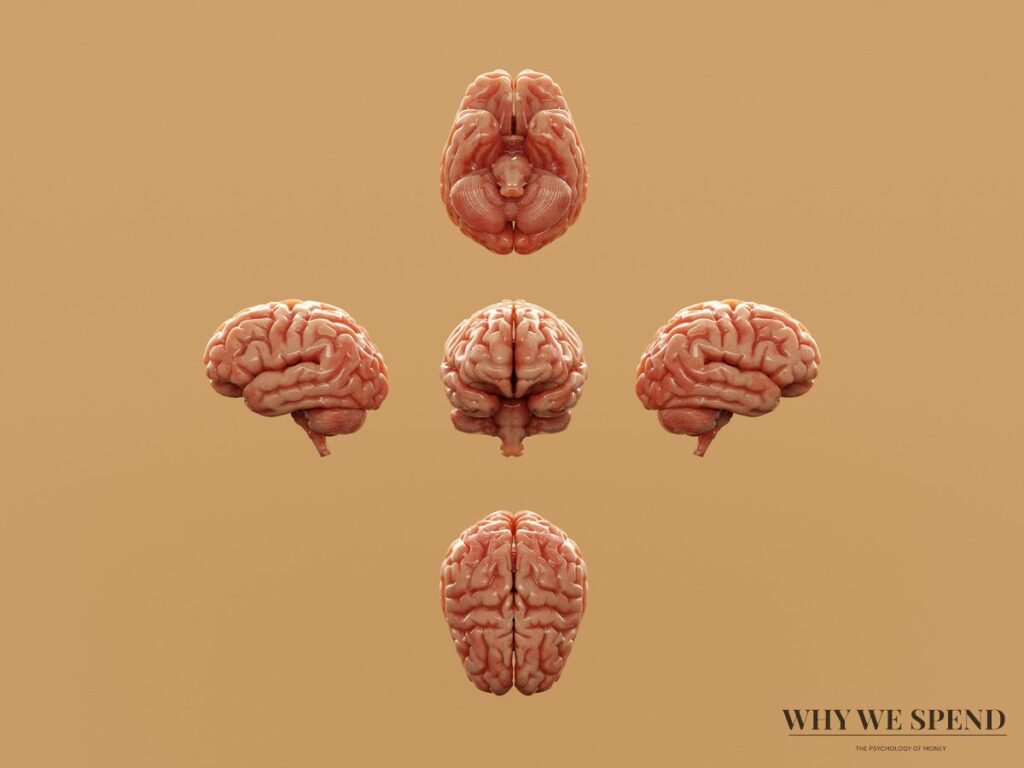
Here’s something that shifted how I think about spending: the pleasure of buying something peaks before you actually buy it.
Neuroscience research has shown that dopamine — the chemical associated with pleasure and reward — spikes hardest during anticipation. The browsing. The adding to cart. The imagining of how good it’ll feel to own the thing.
By the time the item arrives, dopamine levels have already dropped. Which is why unboxing is exciting for about four minutes, and then the thing just sits there while you’re already scrolling for the next hit.
This explains a lot. It explains why people collect packaging they’ll never open. Why a wardrobe full of clothes still feels like “nothing to wear.” Why the holiday you spent weeks planning is somehow less thrilling than the planning itself.
You weren’t buying the thing. You were buying the feeling of anticipating the thing. And your brain is very good at getting you to repeat that loop.
Why Social Comparison Hits Harder Here

If you grew up in Malaysia or Singapore, you’ll know that money is rarely just about money. It’s about face. About what your relatives think at Chinese New Year. About whether your car says something about where you’ve gotten to in life.
Social comparison theory — the idea that we constantly measure ourselves against others around us — is universal. But in Southeast Asian culture, the external pressure is particularly loud. We grow up in environments where success is visible and public, where “doing well” often means being seen to do well.
The problem isn’t that we care what others think. That’s normal human wiring. The problem is when that comparison starts driving spending decisions we can’t actually afford. When the upgrade, the holiday, the bag — isn’t for you. It’s for the narrative you’re performing for everyone else.
And social media has made it worse. Your feed is a highlight reel of purchases, travels, and milestones. Every scroll is a comparison. Every comparison is a gap between where you are and where they appear to be. Your brain reads that gap as a threat — and spending, even briefly, can feel like closing it.
You’re Not Undisciplined. You’re Under-Informed.
Willpower is real, but it’s also limited. Research from Stanford psychologist Roy Baumeister found that self-control is like a muscle — it fatigues. The more decisions you make in a day, the weaker your resistance gets by evening. That’s why late-night online shopping exists as a genre.
Telling yourself to “just have more discipline” is like telling someone with a broken leg to run faster. The framework is wrong.
What actually works is designing your environment so that your wired-for-impulse brain has fewer chances to override your intentions. Not white-knuckling every purchase. Reducing the number of moments where willpower is even required.
Your Takeaway: The One Thing to Do This Week
Before your next non-essential purchase — anything that wasn’t planned — run it through this three-question pause:
- Am I buying this, or am I buying the feeling of buying this?
- Would I still want this if nobody else could see it or know about it?
- Is future me going to be glad I did this, or will I forget I even own it?
You don’t need to answer “no” to all three to justify not buying. You just need to slow down long enough to hear your own answer. That gap between impulse and decision is where real choice lives.
You’re not bad with money. You just haven’t had the right lens to look at it through. That changes now.
WhyWeSpend explores the psychology behind how and why we spend — because understanding the why is the first step to changing the what.